
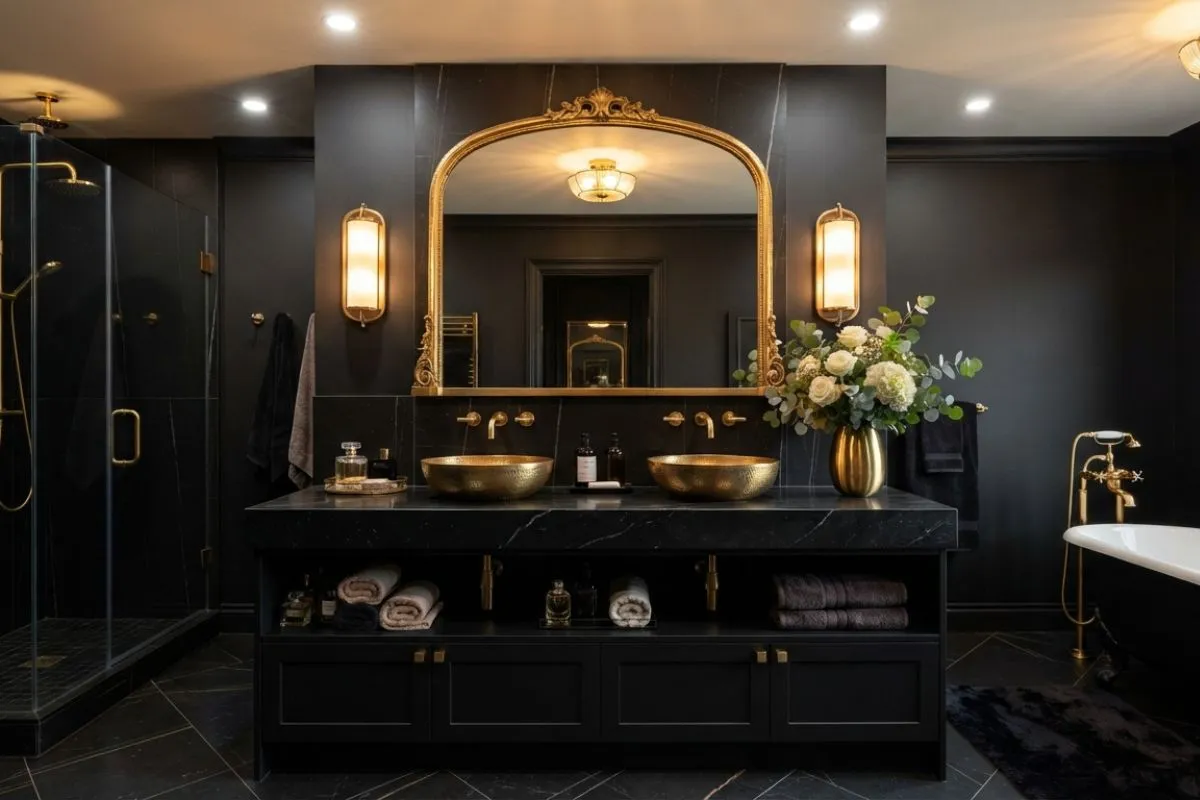
Most black and gold bathroom galleries show you pretty rooms and stop there.
But how much black is too much before the room starts feeling smaller instead of more luxurious? They don’t tell you how much black to use before the room starts to feel like a cave, or which gold finish will still look sharp in three years instead of smudged and dull.
This guide shows you exactly how designers balance black and gold and explains which gold finishes hold up best over time.If you’re approaching your bathroom as part of a wider home transformation, our guide to luxury master bedroom design ideas shows how to carry the same intentional design thinking through every room in your home.
What’s the Right Ratio of Black to Gold in a Bathroom?
Interior designers describe the 60-30-10 rule as a concept rooted in the Golden Section, a mathematical approach to balance and proportion that’s been used to organize color in a room for decades.According to Architectural Digest, it remains one of the most reliable frameworks professional designers return to regardless of the color palette involved.
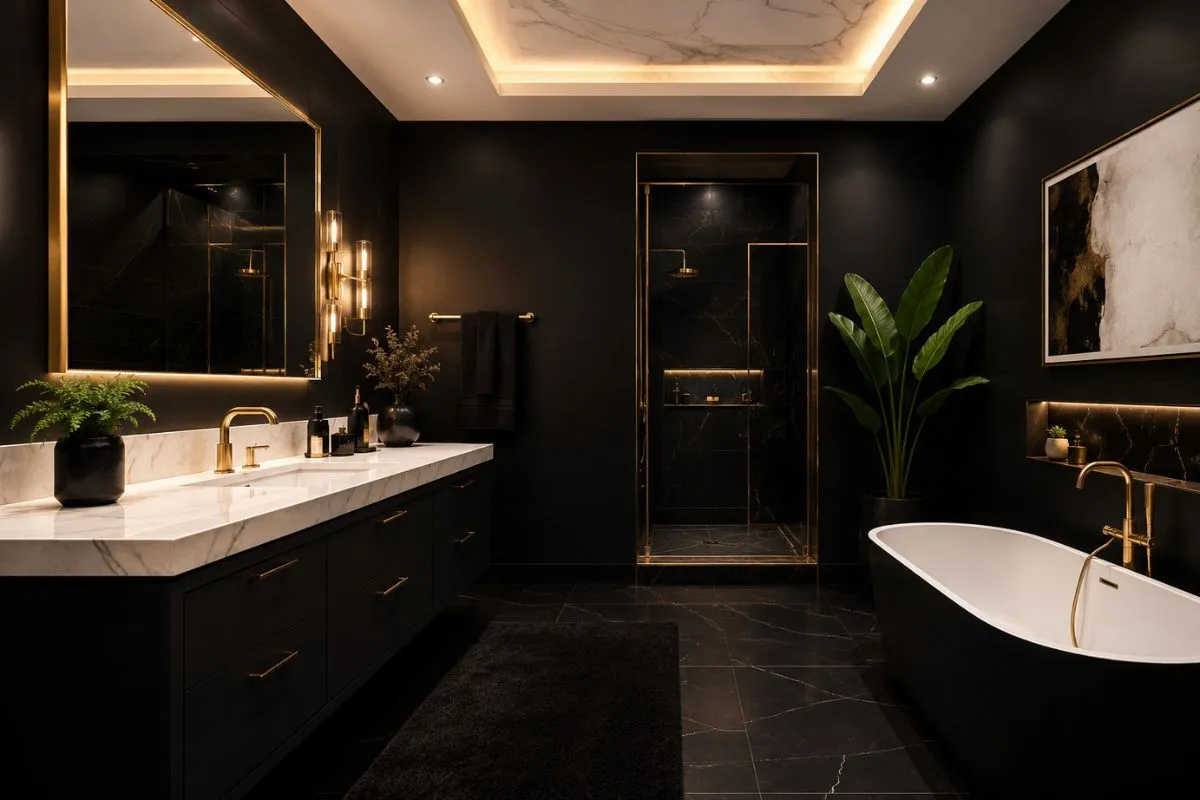
Apply it to a black and gold bathroom, where black covers 60% of the room as the dominant tone (walls, floor, or tile), a secondary neutral like white or warm stone takes 30%, and gold stays the accent at roughly 10%, on fixtures, hardware, mirror frames, and lighting.
In this way, they never ended up like a cave or a jewelry store display case, but rather like a room you actually want to be in.
If you want to transform your existing white or cream bathroom, you don’t need a full renovation to test a black and gold bathroom look. Swap the hardware and lighting to gold first, your 10%, live with it for a few weeks, then decide how much black you want to add for the 60%.
Why Your Gold Finish Matters More Than the Color Itself
Just because two fixtures look gold doesn’t mean they’ll age the same way. One might still look new after five years while another starts showing smudges and wear much sooner. That usually comes down to how the finish was made and whether it’s shiny or textured.
PVD:The Finish Standard Worth Knowing

Most durable gold and brass-toned faucets today use a process called PVD “physical vapor deposition”. The finish material is vaporized inside a vacuum chamber and bonds to the base metal at the molecular level instead of being sprayed or plated onto the surface. This creates a much stronger finish that resists scratches, tarnishing, and damage from everyday cleaning products.
If you’re choosing hardware for a black and gold bathroom that gets daily use, check the product listing for PVD before you check the color name.
Polished vs Brushed: Which to Choose
Texture matters just as much as the coating. A polished gold finish reflects light and looks striking in photos but it shows every fingerprint and water spot within a day of use. If your household includes children or you dislike wiping down fixtures constantly, brushed gold is the more forgiving choice.
A brushed or satin gold finish has a soft, low-glare texture that hides smudges and is easier to live with around a sink you touch multiple times a day. If the room is a guest powder room that gets light use and you want maximum drama, polished gold earns its keep.
The One Finish Rule You Cannot Break
Never mix warm yellow gold with cool champagne gold in the same room. Pick one gold undertone and stick to it across the faucet, cabinet hardware, mirror frame, and light fixtures or the metals will visually compete instead of looking harmonious.
According to House Beautiful, mixing metal temperatures is the single most common mistake homeowners make when attempting a luxury bathroom finish and the easiest one to avoid with a little planning upfront.
Using AI to Visualize Your Black and Gold Ratio
Before committing to black walls or marble tile, it’s worth seeing how the ratio actually looks in your space first. Tools like Midjourney, Adobe Firefly, and Canva’s AI image generator let you create a rough visual mockup in minutes no design skills needed. Just describe your bathroom in plain language: “matte black walls, white marble vanity, brushed gold fixtures, warm lighting.” Adjust the description until it feels right.
It won’t be architect-precise, but it’s enough to tell you whether 60% black suits your specific bathroom before you spend a single dollar on materials or book a single tradesperson.
10 Black and Gold Bathroom Ideas That Hold the Ratio
These 10 black and gold bathroom ideas show practical ways to combine matte black finishes with elegant gold accents, whether you’re making a small update or planning a complete bathroom remodel.
1. Matte Black Walls With Brushed Gold Fixtures
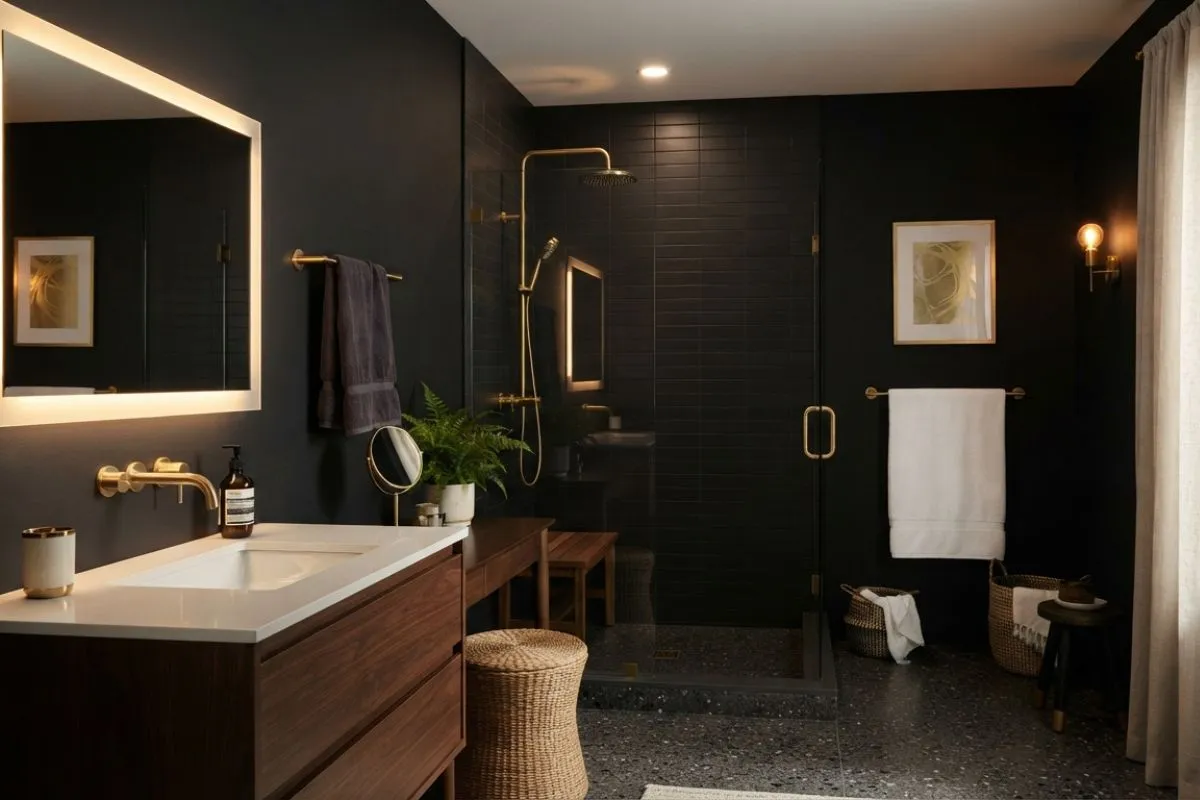
Matte black paint on the walls fulfills the 60% in one move.
It absorbs light instead of reflection, so pair it with a brighter light source and a large mirror to bounce some of the light back. Brushed gold faucets, a showerhead, and a towel bar supply the 10% accent without competing with the wall color for attention.
This pairing is the most requested starting point for a black and gold bathroom because it’s easy to picture and easy to price out.
2. Black Marble Tile With Gold Veining

Veining of natural gold in black marble is one of the most requested materials for a black and gold bathroom because the pattern is never repeated tile to tile.
Genuine marble is expensive and requires regular sealing. Large-format porcelain tiles with a marble look offer a more practical alternative for shower walls and accent panels.
3. Black Vanity With Gold Hardware
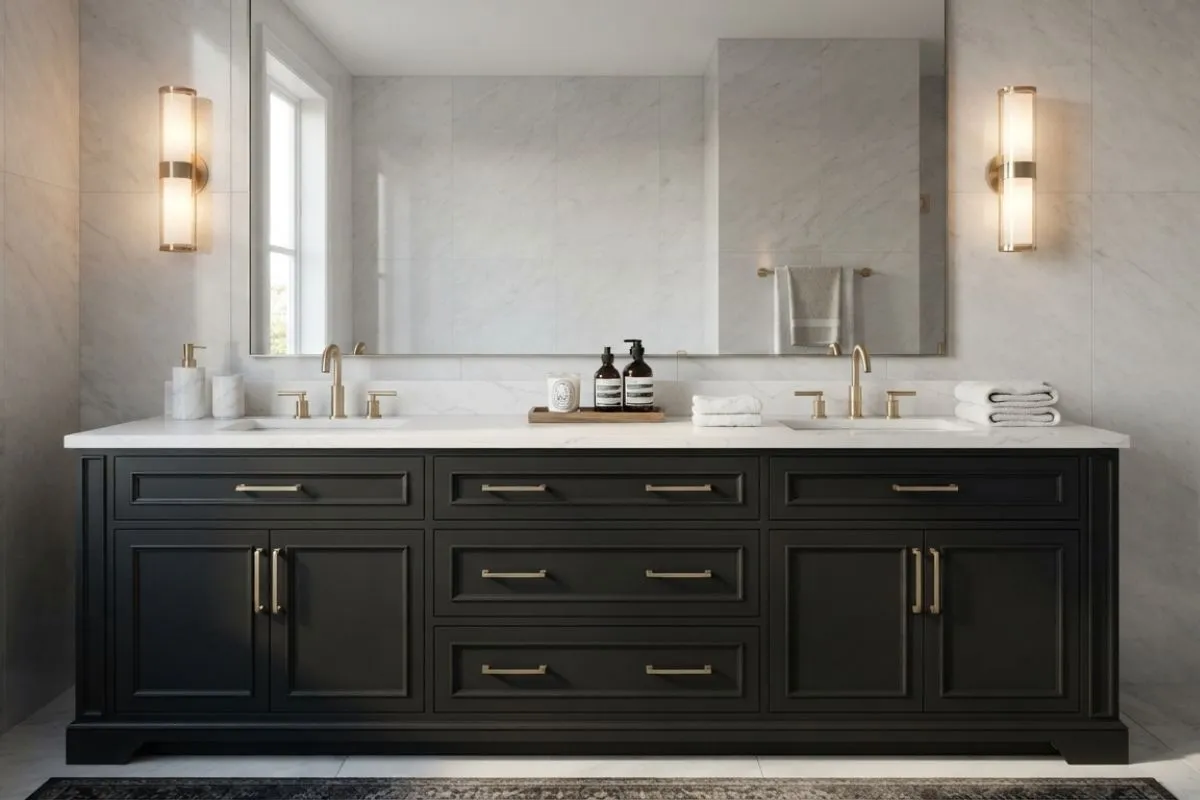
A black vanity cabinet, whether glossy lacquer or matte wood, is one of the easiest ways to bring the 30% secondary tone into a black and gold bathroom. Swap the stock pulls and knobs for gold hardware. This way, the cabinet does double duty as storage and as a design anchor for the room.
4. An Oversized Gold-Framed Mirror
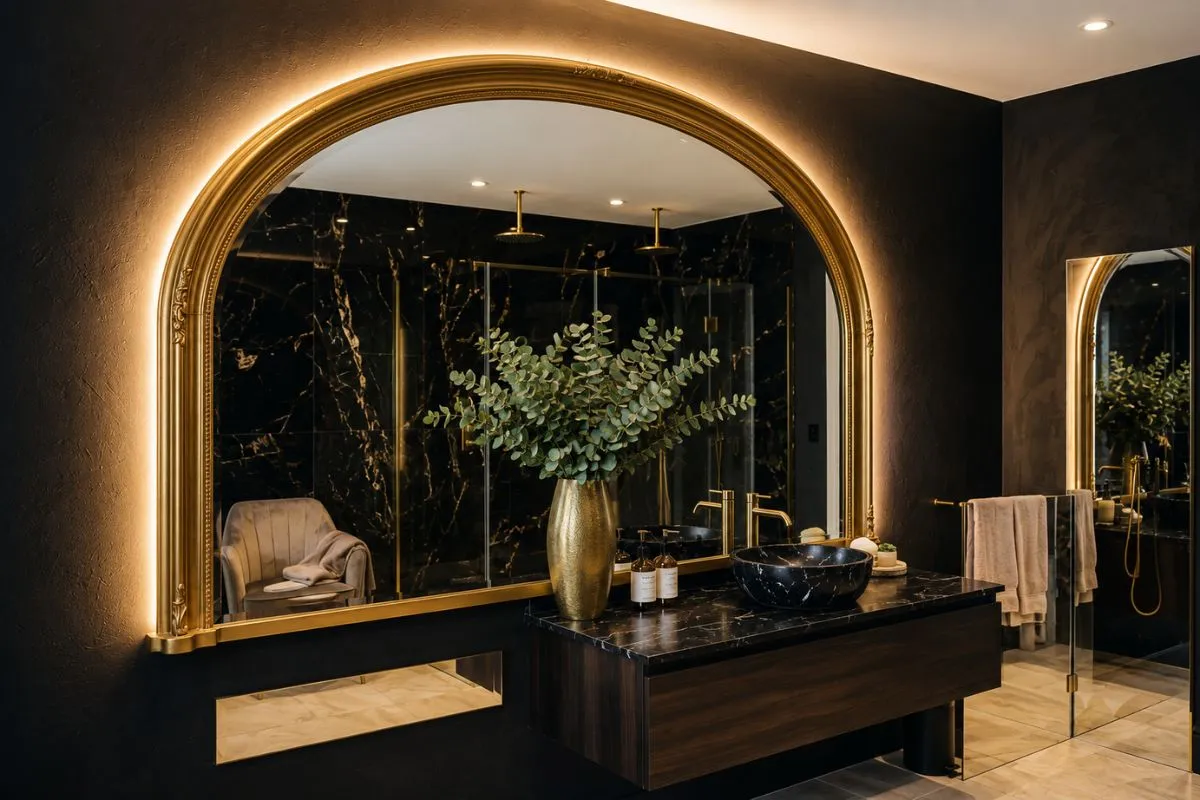
A single large mirror in a gold frame is often the quickest way to hit your 10% gold accent in a black and gold bathroom, since one fixture covers a lot of visuals.
Choose an arched or round shape over another rectangle if the rest of the room is full of straight lines, so the mirror deliberately cuts the focal point rather than another box on the wall.
5. Black Subway Tile With Gold Grout or Trim
Classic subway tile in matte black adds texture to a black and gold bathroom. Pair it with gold-tinted grout or finish it with a thin gold trim strip. Either option gives you the black and gold combination without the cost of slab marble. It works especially well on a shower wall. The grid pattern catches light differently than a flat painted wall would.
6. A Freestanding Tub With Gold Fixtures

A freestanding tub, in white for contrast or black for drama, becomes the centerpiece of a black and gold bathroom when paired with a gold floor-mounted or wall-mounted filler. Position it where it can be seen from the doorway, since this combination is meant to be the first thing a person notices when they walk in.
According to Elle Decor, the freestanding tub paired with contrasting metallic fixtures is one of the most enduring symbols of genuine bathroom luxury as relevant in 2026 as it was a decade ago.
7. Gold Pendant or Sconce Lighting on a Warm Bulb
Lighting temperature is easy to overlook in a black and gold bathroom, but it changes how the gold reads against the black surfaces. A warm bulb in the 2700 to 3000 Kelvin range makes gold fixtures glow instead of looking flat under harsh white light.
Wall sconces flanking the mirror or a single pendant over the tub add both function and a second layer of the 10% accent.
8. A Black and Gold Wallpaper Accent Wall
Wallpaper carries more personality than paint per square foot. A black and gold geometric or art deco print on one wall keeps the pattern from taking over the whole room.
Before installation, confirm the wallpaper is moisture-resistant. Keep it away from the shower or tub area. Let it stand as the one bold gesture in the space everything else stays clean and simple.
9. A Black-Framed Shower Enclosure With Gold Details
Swap a standard chrome shower frame for a matte black one, then add gold hardware, a gold handle, or gold hinge caps.
The black frame reads as part of your 60%, and the gold details stay small and intentional in a black and gold bathroom, exactly where the 10% rule wants them.
10. Flip the Ratio for a Small Bathroom
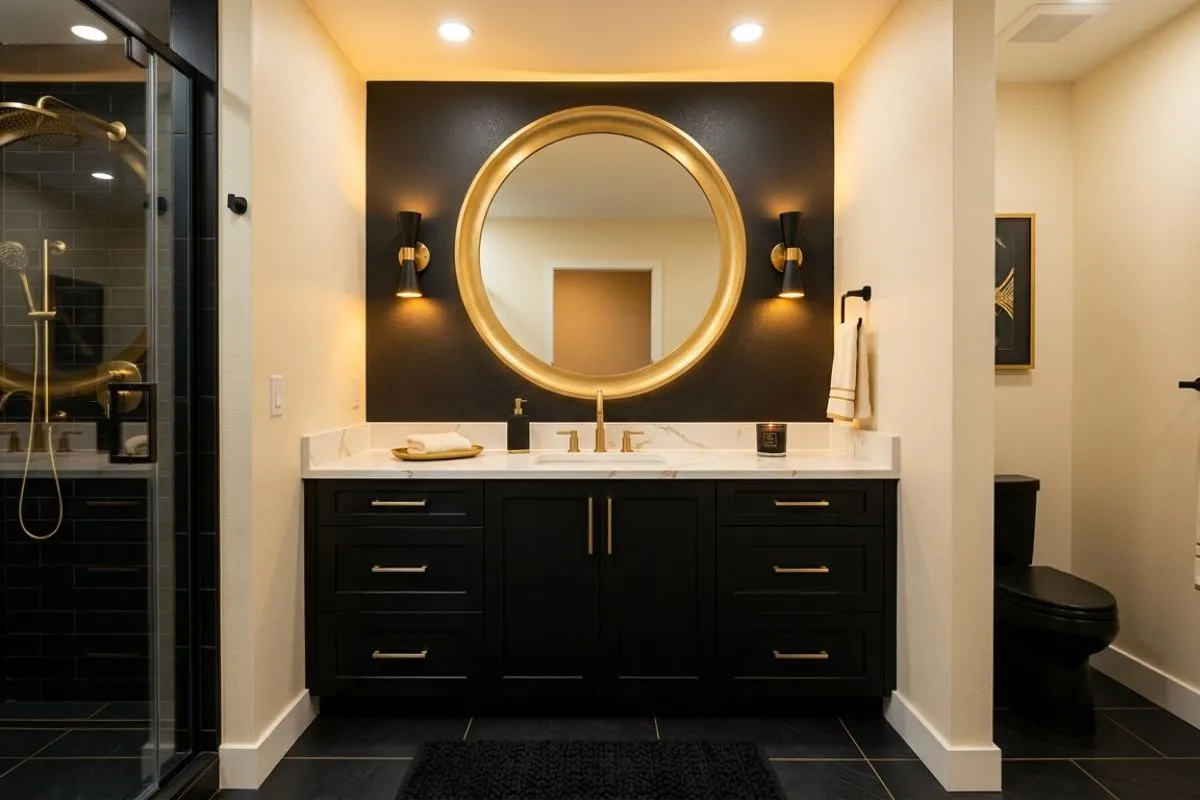
In a small or windowless bathroom, too much black can make the walls feel closer than they are. Instead of black at 60%, try a light neutral wall at 60%. Let gold fixtures and an oversized mirror take closer to 20%. Reserve black for a vanity, floor tile, or a single accent wall.
Gold does more of the work reflecting light this way. The room still reads as a black and gold bathroom. But it carries none of the weight of full black walls.
Final Thoughts
A black and gold bathroom done well is one of the most striking rooms in a home. Done without a plan, it’s one of the easiest to get wrong. The 60-30-10 ratio gives you the structure. Choosing the right gold finish gives you the longevity. And the 10 ideas above give you a starting point at every budget level from swapping hardware to installing black marble from floor to ceiling.
Start with the gold. Live with it. Then add the black deliberately.
Frequently Asked Questions
Q1:Is a black and gold bathroom a trend, or is it timeless?
The combination has appeared in interior design across decades. It spans from art deco interiors to modern glam renovations. Black and gold are both neutral enough to pair with almost any other color. They are also bold enough to read as intentional. This is why the pairing never feels tied to one specific era.
Q2:Does black and gold work in a small bathroom?
Yes, flip the standard ratio. Use a lighter neutral as the dominant 60% color. Let gold fixtures and a large mirror do more of the visual work. Reserve black for one accent wall, the vanity, or the floor tile. Avoid applying black to every surface in a small bathroom.
Q3:What’s the difference between brass and gold fixtures?
Brass is a metal alloy of copper and zinc. It can be finished in many gold tones from warm antique brass to bright polished brass. Gold fixtures are usually made from brass, stainless steel, or zinc alloy. A gold-colored coating is then applied over the base metal. The most durable method for this is PVD.
Q4:Which gold finish resists fingerprints best?
Brushed or satin gold hides fingerprints and water spots far better than polished gold. The textured surface scatters light instead of showing a smooth reflective smudge.
If the fixture will be touched every day, such as a sink faucet or shower handle, brushed gold with a PVD coating is one of the most practical choices for a black and gold bathroom.
Q5:How do I keep a black and gold bathroom from feeling too dark?
Use at least two light sources, such as ceiling lights and sconces. Choose warm bulbs and include a reflective surface to bounce light around the room.
Matte black absorbs more light than a lighter wall color would, so the lighting plan matters more in a black and gold bathroom than it does in a pale one.